Will Committee for Judicial Nominations be Eliminated in New York?





Dan Clark: Let's start there (the committee for judicial nomination) with this week's panel, Zach Williams is from The New York Post and Josh Solomon is from the Time Union.
So this commission, the people that I've spoken to within the Court of Appeals and in the legal community have said that ending this commission would not be a great thing for ethical reasons, that the commission is designed in a way to kind of separate the governor from this process.
What are you hearing about that?
Josh Solomon: Well, the state Bar Association hasn't come out officially, but Bar Association groups or good government groups, the same folks who pushed this commission 50 years ago are really upset. I mean, this is to them, this is completely flipping the entire constitutional amendment on its head, and Majority Leader Andre Stewart-Cousins would say, yeah, it doesn't work, so let's remove it.
But the point was to insulate the process, at least from some, what lawmakers at the time called “bad politics” and seeing what they could do to at least strip some of the partisanship and some of not only actual politics, but the perception of politics and that was important to the framers of this amendment.
DC: It's interesting because I feel in the past decade and probably before that, too, Albany has had a trend of creating these panels and commissions to basically push off the legislatures, not duty, but to delegate what they want to do. There's one that decides how much the executive gets paid, how much the judiciary gets paid, that kind of thing. So I'm interested to see that they want to kind of reverse that, because I could see a situation down the line where they would regret that decision. You know, if in the next gubernatorial election, what if a Lee Zeldin wins and then he can pick whoever he wants with that change?
I don't want to dwell on that too much. I'd like to talk about the judges in particular, not them in their records but, I failed to mention before that Caitlin Halligan has been nominated to replace Rowan Wilson on the Court of Appeal since he will or would presumably be the Chief Judge in the confirmation that may or may not take place next week.
Zach, with these two nominees, but particularly with Rowan Wilson, do you see this being a smoother process than with LaSalle? Seems like he has some general support from Democrats.
Zach Williams: I would certainly say thus far it's been way smoother than the nomination of Hector LaSalle, the Brooklyn appellate judge that just went down in flames a few weeks ago.
Dan Clark: Low bar for smooth.
ZW: You know, the important thing to remember is the court of appeals, the state's highest court has for years been dominated by so-called conservative majority. Now, Hector Lasalle's nomination was seen as a sign that that majority was going to hold for years, you know, 12 year term after all. But now with Rowan Wilson, who's been described as a liberal judge, very competent, very smart, but definitely more to the left than Hector LaSalle, that will not only put a liberal as the Chief Judge, the head of the seven-member court, but then have Caitlin Halligan gets approved, also someone described as a liberal, then that would create a 4-3 liberal majority on the court, and that could have big implications, not least the congressional lines in 2024.
State Attorney General Letitia James, with the support of the governor, has launched a lawsuit to try to undo those lines that that helped Republicans flip several House seats in New York and take control of the U.S. House.
Now, if the Court of Appeals rules on this case, which seems pretty likely and voted to strike down those lines, we could see congressional districts that are much more friendlier to Democrats next year than they were in 2022, especially when you consider that it's going to be a presidential year, President Biden or wherever the Democratic nominee is, will be at the top of the ticket, turnout will be higher, and if the lines are better for Democrats, it's even more likely that the Democrats will take the House back.
JS: I should say that it wasn't just Attorney General Letitia James who launched the lawsuit, she's coming on trying to say, I'd like to join this lawsuit, which is really being run by the Democratic Congressional Campaign Committee, who are basically saying we would like better lines and the Republicans have said we want these lines instead and they've touted their lines that they got instead as an attribute to why they have the majority.
ZW: And this gets back to commissions. You were just saying that the legislature for years has been kind of delegating its authority to outside panels, kind of ostensibly in the name of good government. Well, that didn't work out so well for them in redistricting. There was a redistricting commission for the first time, blah, blah, blah, it deadlocked, it didn't come up with any single set of maps, the Democratic legislature jumped in, drew lines that many saw, especially in the congressional map, were clearly gerrymandered at least to some degree, and the Republicans sued, overturn them and took the House.
DC: You know, any state case can get up to the court of appeals. So, it's interesting to like look at where things are right now. For example, former President Donald Trump has been indicted on felonies, that case could eventually make it to the court of appeals, where Rowan Wilson may be the Chief Judge. So all these seeds are planted right now in litigation, and you have to think because a lawsuit doesn't get filed on a Monday and go to the state's highest court on a Friday, there's like two years for the first trial court, maybe a year for the next court, so it's a very long process, and it's something that will have to watch over a number of years.
You're right, his record is pretty liberal, but I'm interested to see how he does on commercial stuff.
JS: I just say quickly, it's smooth right now, this process with the two nominees, well, one is a nominee, the other is a presumptive nominee, that presumptive nominee, Caitlin Halligan, there could be a lawsuit that may be filed on Monday that could challenge the process in which she's being nominated through this program bill, that the governor has put forward, that the legislature adopted, that she signed into law.
This process could all kind of blow up on Monday, and right now it is smooth, but there may be a cliff that we're not realizing we're approaching.
DC: I would be surprised if someone does not sue over that. I mean, I'm not a lawyer, I didn't go to law school, I don't have any legal training, but I did work for the New York Law Journal, which is kind of like law school a little bit…
ZW: Same thing.
DC: … and the Commission on Judicial Nomination is in the state constitution. So to me, as I'm thinking about a way that an attorney would file this lawsuit, not to give anybody any ideas, it's changing a process that is in the Constitution through a state law, not amending the state constitution. So I could see that as an argument, I don't know, we'll have to see. Maybe I'm totally wrong.
Not lot that we need to talk about on the budget, honestly, but Zach, I'll go to you first. Bail has kind of dominated the conversation, discovery reform is now kind of part of it, but now housing is becoming a big budget blocker as well. Is that right?
ZW: That's what I heard from a well-placed source just yesterday. What is so interesting about housing is, you know, a lot of the discussion in the budget is the governor wants this, will the legislature go along with it. With housing, it gets a little bit more complicated because obviously the legislature wants to do something on housing and is not so eager to do something on bail necessarily.
The governor, she has her housing compact, very controversial in the suburbs, supposedly would undermine local zoning control in order to promote construction, but the Democrats in legislature got their own asks as Assembly Speaker Carl Heastie made clear a few days ago when I asked him. You know, there's been a lot of talk about the good to cause eviction bill, and he kind of alluded to that and I asked him to elaborate what does the legislature want, he mentioned rental assistance for public housing residents.
New York City is one, you know, a new Mitchell-Llama affordable housing program for middle class people maybe would be in the cards. So, I think with housing, whatever happens with the controversial enforcement mechanism in the governor's housing plan there'll be negotiations on that, but the governor's going to have to also play ball and give the lawmakers something that they want, especially lawmakers from New York City, who clearly want to really channel a lot of this housing energy into New York City, where I think everybody knows affordable housing crisis is at its worst.
DC: Oh, yeah, absolutely. I don't know if good cause makes it in in its in its current form. I'd be surprised if they kind of just took the bill and put it in. I could see a situation where there is kind of a compromise there and they take some parts of good cause and leave other parts out.
ZW: Good cause kind of skews to, you know, the assembly had some vague language in their one-house budget resolution that sort of said, yeah, we want to protect tenants, and the state Senate had something stronger, but it's very unclear the extent to which the legislative leaders will go to bat for good cause, a darling of the political left, but they're certainly going to at least try a little bit, not least to kind of assuage some of their members who really want this.
That said, rental assistance and a whole bunch of other items besides the governor's housing compact seem to be part of this whole mishmash of housing that seems to be holding up the budget as much as bail, certainly at this point.
DC: Josh, give us a quick update on bail.
JS: Some say it's done, some say it's not done and some say if it is done, that is a problem, because that means that there would be, “roll backs” of it. There's a lot of consternation over the criminal justice issue still, which means even a crunchy issue on housing would make the budget delay even longer, and who knows when we'll finish. Maybe next week, we'll say the budget is still in negotiation.
DC: You know, with the confirmation hearings on Monday and maybe Tuesday, I don't know if they do vote on a budget next week, but we will see.
Josh Salmon from the Times Union, Zach Williams from The New York Post, thank you both so much.
Watch the Interview
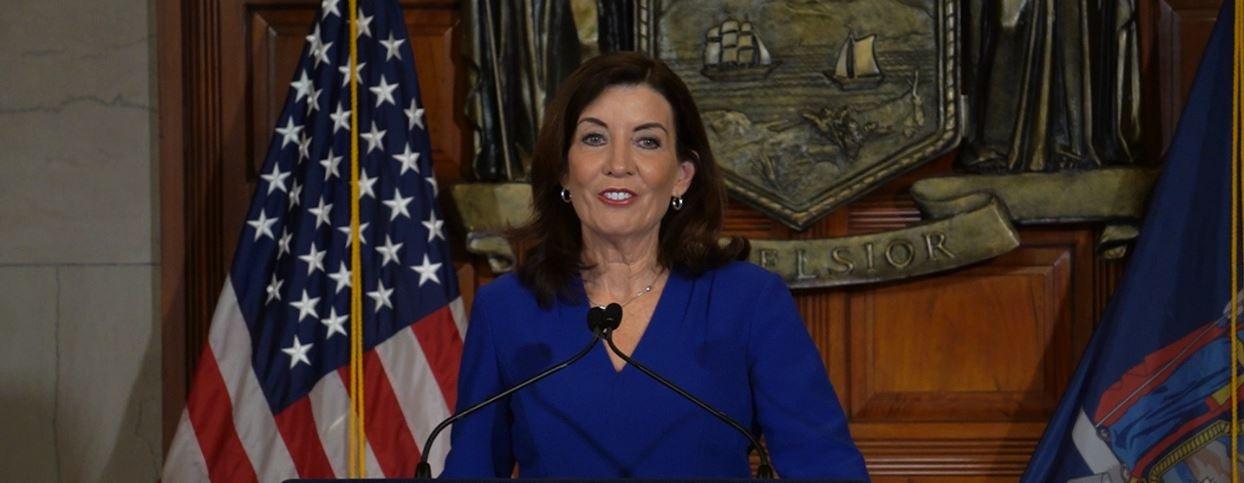
New York Governor Kathy Hochul has nominated Rowan Wilson to be the next chief judge. New York State Senate Democrats are looking to eliminate the commission for judicial nomination and give more power to the governor in picking judges. Zach Williams from the New York Post and Josh Solomon from the Times Union join with analysis on this along with the latest on the state budget.