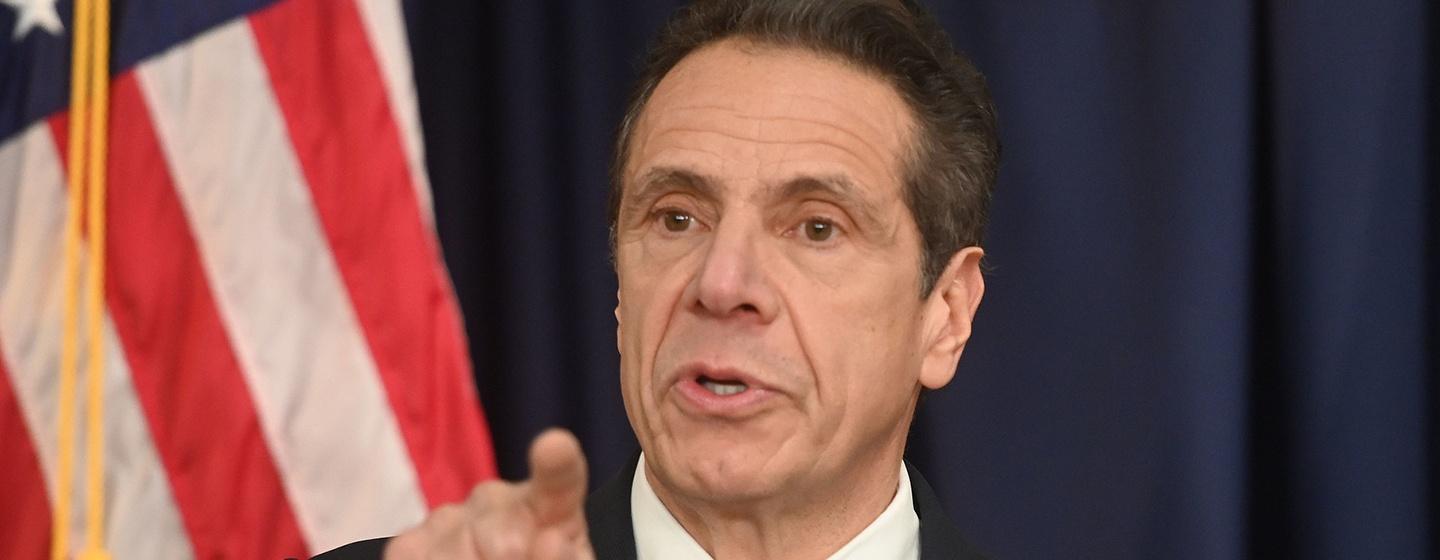


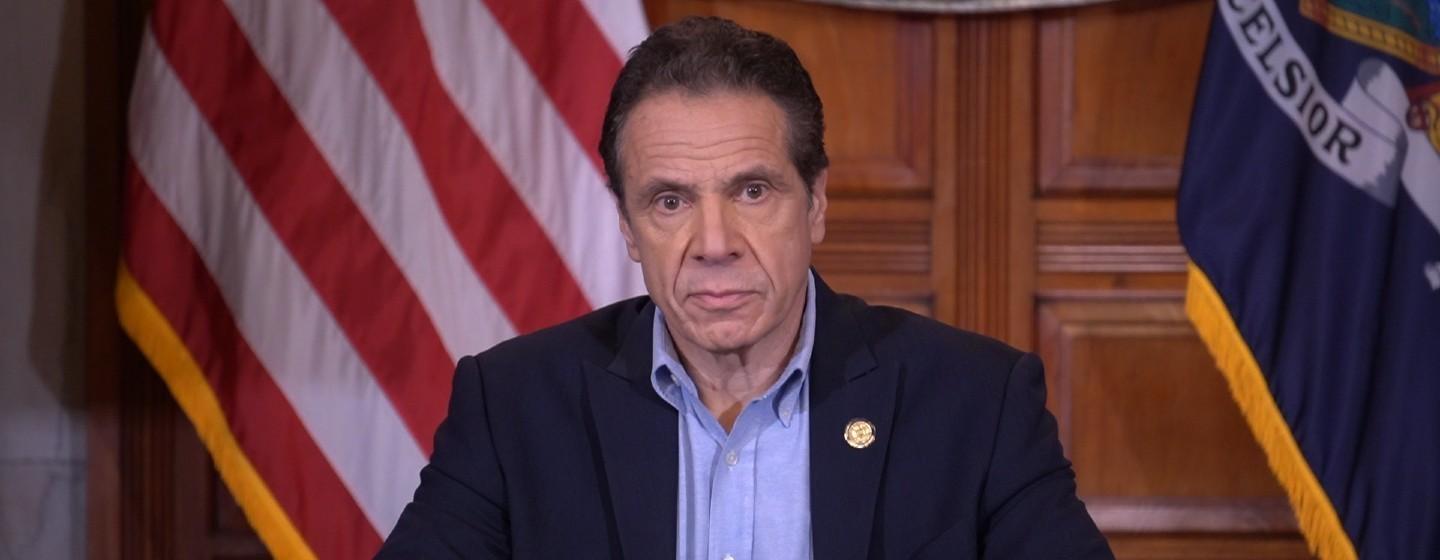
Gov. Andrew Cuomo made a plea to business in New York state on Sunday to allow employees to work from home, when able, and consider closing physical locations voluntarily as a way to contain the spread of the novel coronavirus, or COVID-19.
He also made a personal call for President Donald Trump to allow the U.S. Army Corps of Engineers to identify locations that could be used as temporary health care facilities.
“Use them to come in right now, identify existing facilities that can be retrofitted, and use them to do it,” Cuomo said.
Cuomo has, in recent days, expressed concern about hospital capacity in New York in the context of the novel coronavirus. New York has 53,000 hospital beds, but only 3,000 intensive care units, which may not be enough for treatment in the long-term, he’s said.
That’s partly because a large share of them, Cuomo said, are already occupied with patients. That means there are only “hundreds” open, as of now, he said.
“The overwhelming crush is going to be on the ICU beds,” Cuomo said. “The critical people are the people who had underlying illnesses and need those ICU beds, and those ventilators.”
Cuomo said he asked Trump to consider allowing the U.S. Army Corps of Engineers to help with responding to the outbreak through a letter Sunday, but hasn’t heard back.
The call came as the number of cases in New York continued to rise Sunday, as the state’s capacity to test for the disease spiked in recent days. New York has been cleared to allow testing at several labs, but capacity is still below what Cuomo’s aiming for.
As of Sunday morning, Cuomo said, there were 729 positive cases of COVID-19 in New York state, and 5,272 people had been tested for the disease since the first case was identified about three weeks ago. About a fifth of the cases in New York have required hospitalization.
Cuomo said a third individual had died after being diagnosed with the disease as well. He said she was a 79-year-old woman in New York City who already had several underlying conditions before contracting COVID-19.
Cuomo said he’s now asking businesses in New York to allow employees to work from home, if possible, and strongly consider closing physical locations until further notice.
“I am asking them to aggressively consider work-from-home strategies,” Cuomo said. “I’m asking them to aggressively consider voluntary closings.”
As the outbreak continues, if businesses are found to have not taken precautions to prevent the spread of the disease, stricter limits may be placed on building capacity, Cuomo said. The state, days ago, ordered businesses to halve their capacity limits.
“Depending on what business do on a voluntary basis we could consider mandatory actions later on,” Cuomo said.
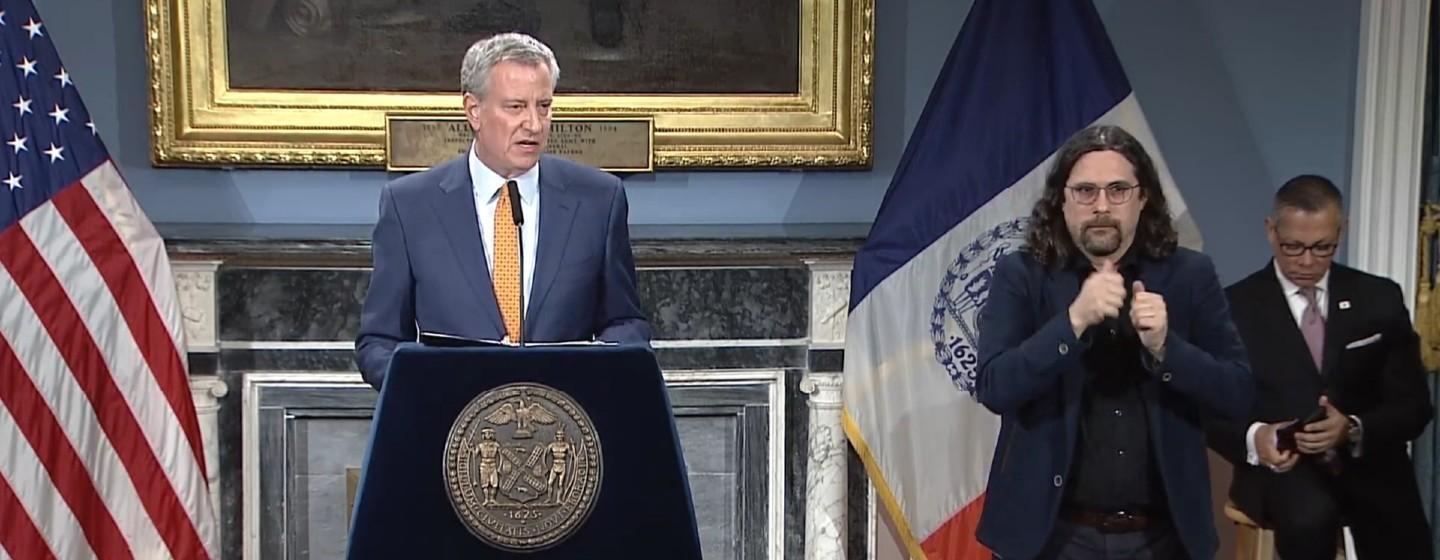
New York City Comptroller Scott Stringer, on Sunday, called for a complete shut-down of New York City to contain the virus, which had more than 300 positive cases of COVID-19 as of Sunday morning.
“Logic says we need universal testing but that’s sadly not happening. Strategy says we need more aggressive social distancing,” Stringer said. “That is why today, out of an abundance of caution, I am calling for a city shutdown.”
Cuomo, when asked about that call, said Sunday that the state wouldn’t be ordering a complete shut-down of the social scene in New York City, as of now, but that the New York City Police Department should be shutting businesses that don’t follow the new capacity limits.
The state is also ordering all non-essential state government workers from Rockland County, Westchester County, New York City, and Long Island to stay home, starting Monday. The order doesn’t apply to state government workers in Albany.
Cuomo pushed back several times when asked if members of the state Legislature should still return to Albany Monday to continue negotiations on the state budget, which is due at the end of the month.
At one point, he likened a suggestion that lawmakers be allowed to forego work at the capitol to soldiers in the army choosing not to go to war.
"If we can ask nurses to put on hazmat suits and take blood, we can ask elected officials to come and sit at a desk and vote on a piece of legislation,” Cuomo said. “Compared to what we’re asking people to do in public service, this isn’t even the same category.”
Both Assembly Speaker Carl Heastie, D-Bronx, and Senate Majority Leader Andrea Stewart-Cousins, D-Westchester, issued statements Sunday afternoon confirming that lawmakers would return to Albany Monday to continue work on the state budget. Stewart-Cousins said they're trying to get it done before the April 1 deadline.
"The Senate will return to the Capitol tomorrow for scheduled Session," Stewart-Cousins said. "Plans are being developed for a future schedule and safety protocols while working towards an expedited State Budget.”
Stewart-Cousins also said the State Senate's offices in New York City will be closed until further notice, and recommended that lawmakers close their district offices.
Heastie, who said Saturday night that two members of the Assembly had tested positive for the coronavirus, said Sunday that his staff was in contact with the state Department of Health to evaluate next steps in terms of testing lawmakers and their staff for the disease. They'll also return Monday, Heastie said.
"This situation is changing rapidly," Heastie said. "Our plan is that members will return to Albany on Monday to take action on important legislation while practicing appropriate social distancing in order to keep everyone safe."
Cuomo said that, with lawmakers in Albany, some issues may fall out of the state budget if there’s not enough time for them to be considered by the end of the month.
“I would not rush an issue that we’re not ready to do, right? I don’t want to pass or sign a bad piece of legislation that is not thought through,” Cuomo said. “So, if there’s a complex issue that’s not thought through, fine.”
Several large policy items were expected in this year’s state budget, like the legalization or marijuana for recreational purposes, and gestational surrogacy. Cuomo’s legislation to ban flavored vaping products was also expected in the budget.
Cuomo and lawmakers are largely in agreement on some of those issues, like a ban on flavored vaping products. But other issues, like marijuana legalization, may be left to the curb in the interest of getting a budget done on time in the midst of a global pandemic.