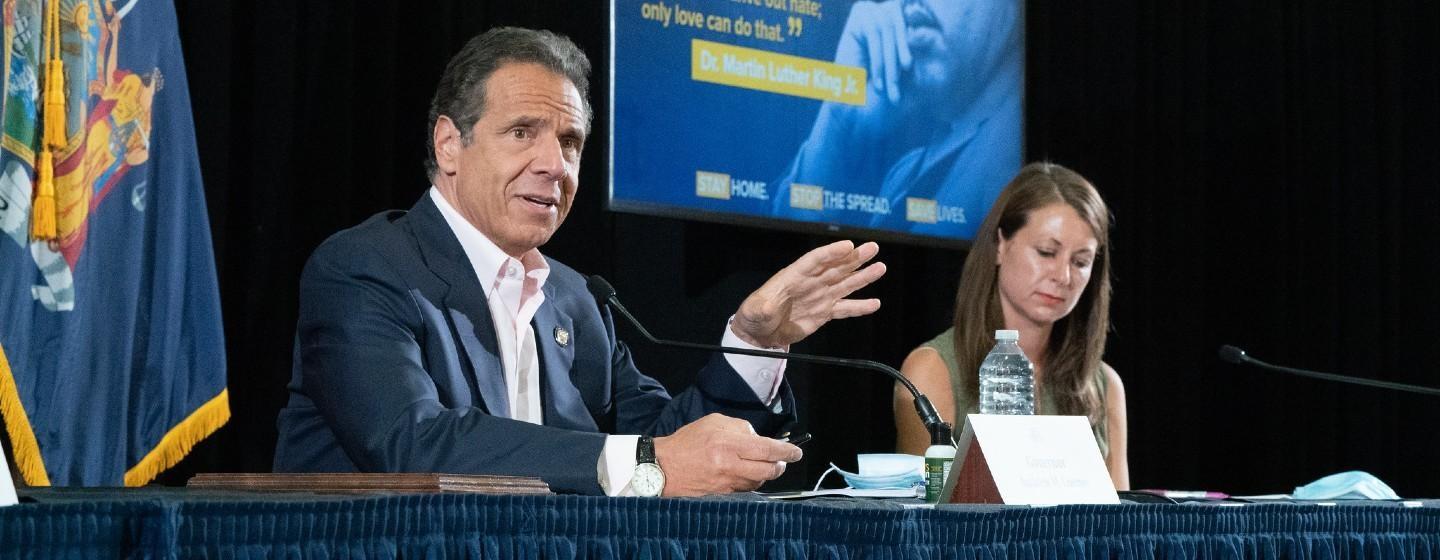



Gov. Andrew Cuomo, in response to another night of chaotic protests across New York state, called for a handful of changes to state and federal law Sunday that he suggested would ease tensions between police and communities of color following the death of George Floyd.
He also responded to an incident caught on video, where a vehicle from the New York City Police Department, was seen driving into a crowd of protesters Saturday night.
“The police are in an impossible situation in many ways. But their behavior is everything,” Cuomo said. “I’ve seen those videos, and those videos are truly disturbing. Some of the videos are, frankly, inexplicable to me.”
Those incidents, Cuomo said, will be added to an independent investigation from the attorney general’s office into conflicts between protesters and police in areas of New York in recent days.
Cuomo, who’s gained national attention in recent months because of the state’s experience with COVID-19, used his televised briefing Sunday to highlight the protests, and how they could influence policy changes at the state and federal levels.
“Change comes in a moment when the stars line up. It’s not easy, but when the stars line up and the people are ready to change, they can change,” Cuomo said. “We have seen it happen in this state and in this nation.”
Some of Cuomo’s proposals could be implemented immediately through action by the state Legislature, which hasn’t announced any plans to return to Albany. But some of Cuomo’s ideas will require coordination between states and the federal government.
For one, Cuomo said he would like to see the federal government, and every state government, approve legislation that would require a special prosecutor in cases of alleged police abuse. In other words, local district attorneys wouldn’t be allowed to handle those investigations.
“Self-policing does not work, period,” Cuomo said. “Allegations must be investigated by an independen outside agency.”
That measure is already in effect in New York — to an extent. Cuomo signed an executive order five years ago requiring the state attorney general’s office to investigate cases where someone dies during an interaction with police, and there was question whether they were armed.
Cuomo has, since, called on the state Legislature to enshrine that executive order into state law, but that hasn’t happened yet.
New York Attorney General Letitia James has supported expanding the order, and subsequent bill, to allow her office to investigate cases where an office is accused of a crime, regardless of whether someone dies as a result. That would include rape crimes, for example.
Lawmakers, in recent years, haven’t been able to agree on language in legislation that would allow the attorney general’s office to permanently be tasked with investigating police misconduct.
Cuomo also called Sunday for changes to state law that would require the disciplinary records of law enforcement officials to be released when they’re accused of wrongdoing and under investigation.
“If a police officer is accused of wrongdoing and is being investigated, release their disciplinary records so people can see what the prior acts of that police officer were,” Cuomo said.
That builds on comments made Saturday by Cuomo, who said he would sign a bill to “reform” section 50-a of the state Civil Rights Law. That section of law has been used by local governments in New York to block public disclosure of disciplinary records.
But it’s unclear if Cuomo supports a full repeal of that law. Some Democrats have said it should be taken off the books altogether, which would allow members of the public to request the disciplinary records of law enforcement and correction officers at any time.
Cuomo’s proposal appears to be more narrow. He said he wants to see those records made available when an officer is accused of wrongdoing and under investigation, meaning the proposal may not allow the public to request them at any time.
He also said that every state in the country should have a uniform definition for what would constitute excessive force by a member of law enforcement. That way, he said, there would be no discrepancy between states.
“Demand that we define excessive force by a police officer by one standard, all across this nation, so every american lives by the same standard,” Cuomo said.
He also touched on education funding, saying that school districts across the country shouldn’t be spending vastly different amounts per student. In New York, there are disparities between school districts, mostly separated between high-income and low-income communities.
That shouldn’t be the case, said Cuomo, who’s said in recent weeks that he may have to slash spending on schools in New York without aid from the federal government.
“There is no reason and no excuse today for any child to live in poverty,” Cuomo said. “We know that. Demand that change.”
For each of those proposals, Cuomo had a suggestion for voters dissatisfied with state and federal lawmakers: kick them to the curb.
“If our government leaders won’t do it, or can’t do it, or don’t know how to do it, then you vote them out,” Cuomo said. “That’s how you make change.”